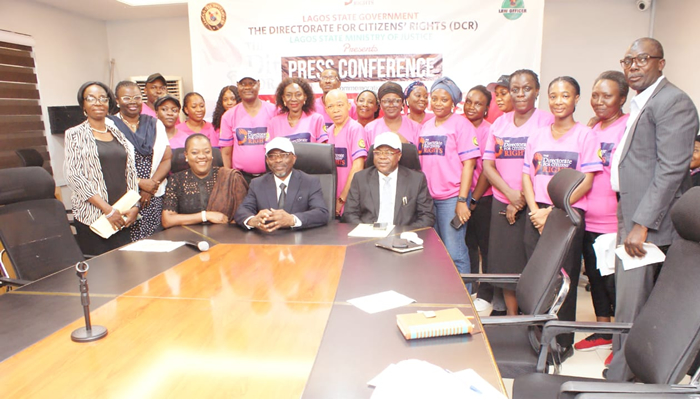
…Reaffirms Commitment to Humane and Community-Centred Justice The Lagos State Ministry of Justice has joined the global community to commemorate the 2025 International Restorative Justice Week, which commenced on Monday, 24th November 2025. The Honourable Attorney-General and Commissioner for Justice, Mr. Lawal Pedro, SAN, reaffirmed the State Government’s unwavering commitment to strengthening restorative justice as a core pillar of the State’s criminal justice architecture. Speaking at a press briefing held on Thursday,, the Attorney-General noted that this year’s international theme, “Restorative Justice as Human Rights,” aligns strongly with the THEMES+ agenda of Governor Babajide Olusola Sanwo-Olu, particularly under Security and Governance. He stated that Lagos State continues to champion people-centred justice and community-based peacebuilding—positioning restorative justice not merely as an alternative, but as an essential tool for promoting access to justice, healing, accountability, and human dignity. Pedro highlighted the progress of the Lagos State Restorative Justice Centre, established in 2022 as the first structured restorative justice framework in Nigeria. He reported that the Centre has received 360 referrals to date, with over 80 percent successfully resolved, resulting in fewer custodial remands, reduced court pressure, quicker justice delivery, and improved community harmony. According to him, the Centre’s interventions include victim–offender mediations, restitution agreements, community service sentencing as a non-custodial measure, and its first multi-party conferencing involving government agencies and a private business entity. The Attorney-General added that most referrals were received from the Magistrate Courts, Directorate of Public Prosecutions, Bureau of Public Defender, and private legal practitioners. However, he noted the relatively low referral rate from the Police, stressing the need for deeper engagement. He assured that the Ministry will strengthen collaboration with law enforcement to enhance the programme’s reach and impact. Pedro further stated that Lagos State’s achievements have positioned it as a national leader in criminal justice reform, with the Lagos model being adopted across states including Adamawa, Anambra, Edo, Kano, Abia, Plateau, and the Federal Capital Territory. He expressed appreciation to Governor Sanwo-Olu for his continuous support, and to the Honourable Chief Judge of Lagos State, Hon. Justice Kazeem Olanrewaju Alogba, for institutional backing. He also commended the EU-funded RoLAC Programme, International IDEA, the Prison Fellowship of Nigeria, the Lagos Multi-Door Courthouse, justice sector stakeholders, and community partners for sustaining the initiative. “As we commemorate International Restorative Justice Week 2025, we make it clear that restorative justice is no longer an experiment in Lagos State. It is now a permanent and indispensable feature of our criminal justice system,” he said. He further called on the Police, justice institutions, community leaders, and the public to continue partnering with the Ministry to strengthen restorative justice and promote peaceful, community-driven resolutions across the State. In her remarks, the RoLAC Coordinator, Mrs. Ajibola Ijimakinwa, emphasised the need to expand public awareness and deepen institutional adoption of restorative justice across Lagos State. She noted that referral numbers remain low compared to the volume of minor offences entering the system, describing this as an area requiring urgent collaboration. “We look forward to increased referrals from Magistrate Courts and even the Police,” she said. “Before now, justice was all about punishment and incarceration. Now we are saying the victim and the offender can come together, discuss what happened and its impact, and reach an agreement that ensures accountability while addressing the victim’s needs.” Speaking earlier, the Solicitor-General, Mr. Hameed Oyenuga—represented by the Director of Public Prosecutions, Dr. Babajide Martins noted that the annual observance provides an important platform for Lagos State to reaffirm its leadership in justice sector reform, strengthen public awareness, and highlight progress since the establishment of the Restorative Justice Centre in 2022. Oyenuga reiterated that restorative justice remains central to the Ministry of Justice’s commitments under the THEMES+ Agenda, particularly in advancing people-centred justice, reducing court burdens, supporting victims, and promoting peaceful conflict resolution across communities. He expressed appreciation to the Attorney-General for his strategic leadership and commended justice sector stakeholders, international partners, and community organisations for their collaboration in promoting humane and effective justice solutions. The Director of the Restorative Justice Centre, Ms. Adeshola Adekunle-Bello, also expressed gratitude to the Attorney-General and the Solicitor-General for their sustained leadership in advancing restorative justice in Lagos State. She noted that their support has enabled the Centre to evolve into a functional, impactful, and nationally recognised model for community-centred justice. She acknowledged the invaluable collaboration of key justice sector institutions—including the Judiciary, Directorate of Public Prosecutions, Bureau of Public Defender, Community Service Unit, District Prosecutors and the Police—as well as partners such as the EU-funded RoLAC Programme, International IDEA, the Prison Fellowship of Nigeria, and the Lagos Multi-Door Courthouse. She added that these partnerships have been crucial in strengthening restorative interventions and expanding access across the State. Adekunle-Bello extended appreciation to community leaders, civil society organisations, and the press for their continued support, and reaffirmed the Centre’s commitment to deepening restorative practices, promoting peaceful conflict resolution, and sustaining Lagos State’s leadership in criminal justice reform.